The itch
I play linebacker in a 7v7 rec flag football league. Every week our defense has the same arguments: man or zone, who rushes, who plays safety, and what to do about the team whose QB only throws to one guy. I wanted answers that came from more than a hunch, so I built a simulator of our league and let it play thousands of snaps.
Our league's rules
- 7 on 7: a QB, a center, and five receivers, and the center can catch passes.
- A narrow field, about half as wide as a regulation one, so the sideline works like an extra defender.
- One rusher on a count of five. Until the count is up the QB can't run; after it he can, and the rusher can come. Nobody times it, so the sim counts the way we do: on our game video, five comes in 2 to 3 seconds.
- That leaves 6 on 6 in coverage, and no pick plays (rubs still happen).
What it does
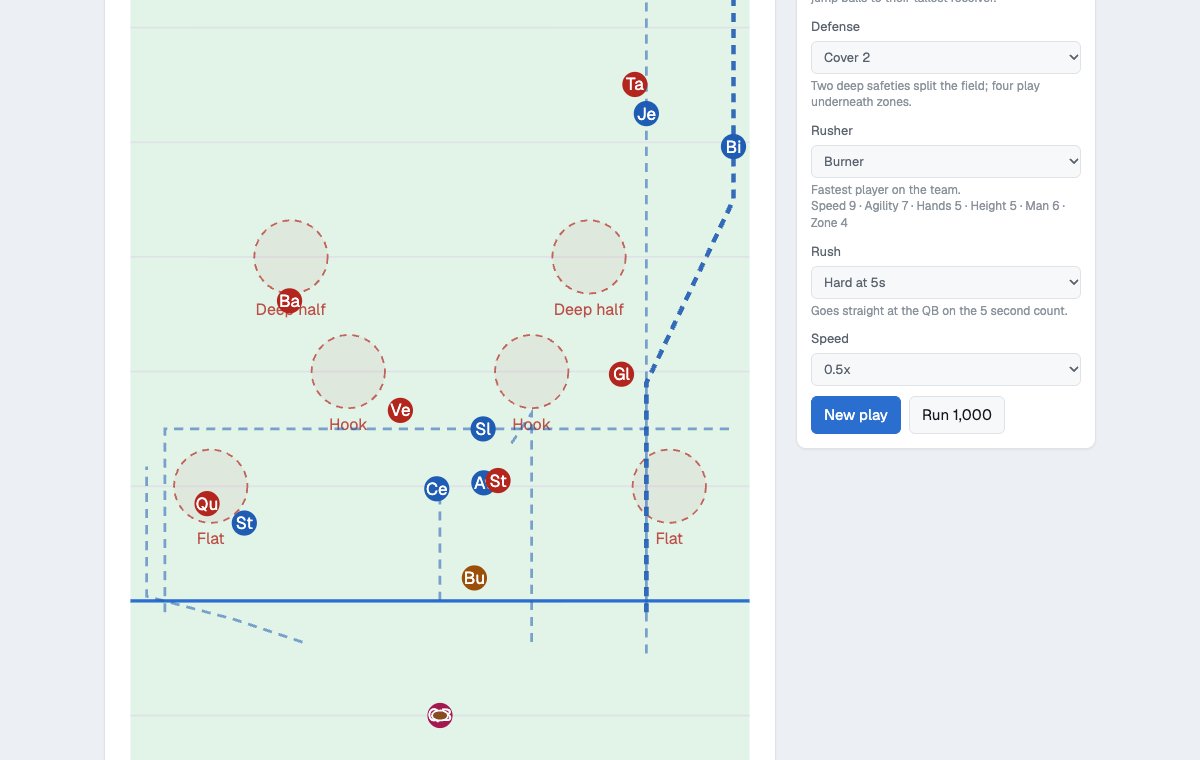
- Play viewer: pick an opponent and a defense, and watch a play on a top-down field with every route drawn. Scrub through it in slow motion, or run 1,000 plays to see the averages.
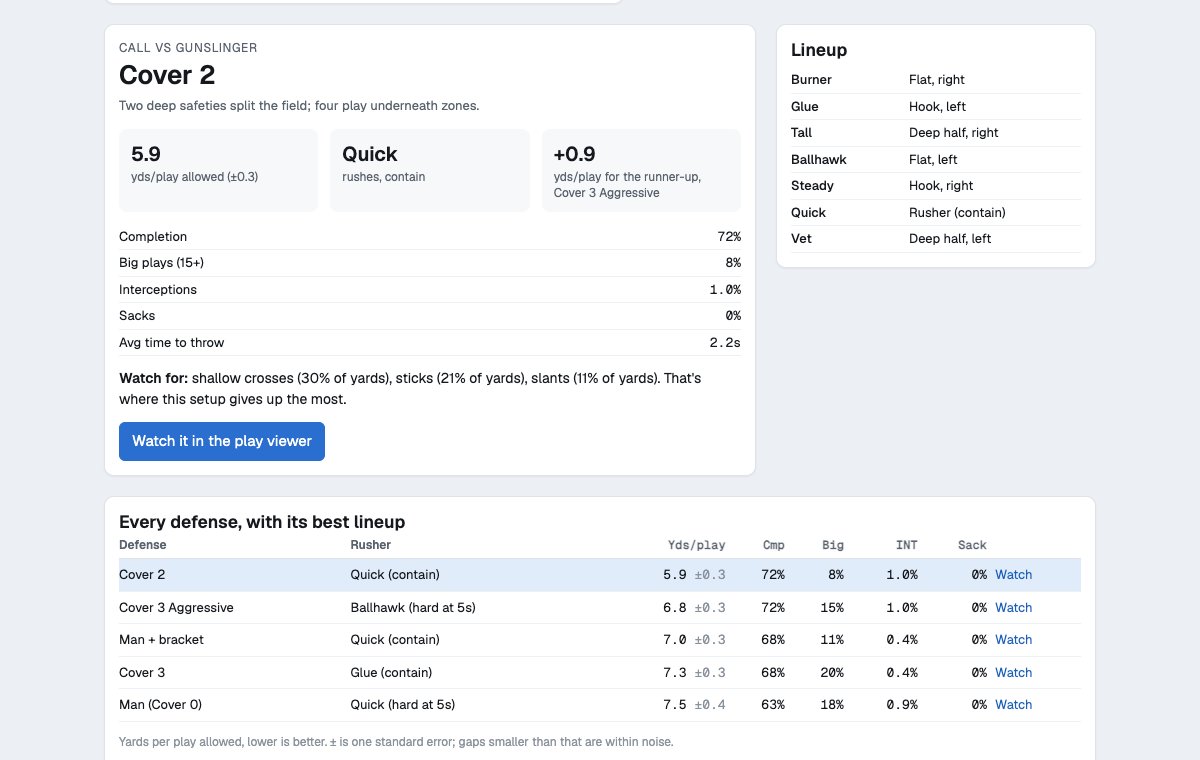
- Best setup: pick an opponent and it finds the best defense for my roster, who rushes, and who plays where, with a diagram of where everyone lines up, the runner-up, the margin, and the routes to watch for. One click shows that setup in the play viewer.
- Roster: build the team from player types (the Burner, the Tall one, the zone-smart Vet, and so on), no real ratings needed.
Opponents come as types I recognize from the league: the Gunslinger who throws deep early, the Dink and Dunk team, Hero Ball (forcing it to one star), the Scrambler, and the Scared QB who holds it forever.
How it works
Each play is simulated ten times a second. Every player has six ratings (speed, agility, hands, catch height, man, and zone) that turn into how fast they run, how sharply they cut, how quickly they react, and how high they can catch, at a rec-league pace rather than a track meet's (friends who tried it said the receivers were too fast). Receivers run real routes from sampled formations. Man defenders trail a step behind, so separation shows up at the breaks. Zone defenders read the QB's eyes, and safeties follow the rule we actually play by: never let anyone get behind you.
The QB is modeled on what I see at our games: he either throws a planned quick pass in the first half second, or uses the count and waits for someone to come open. Catches, interceptions, missed flag pulls, and yards after the catch all come out of the same physics.